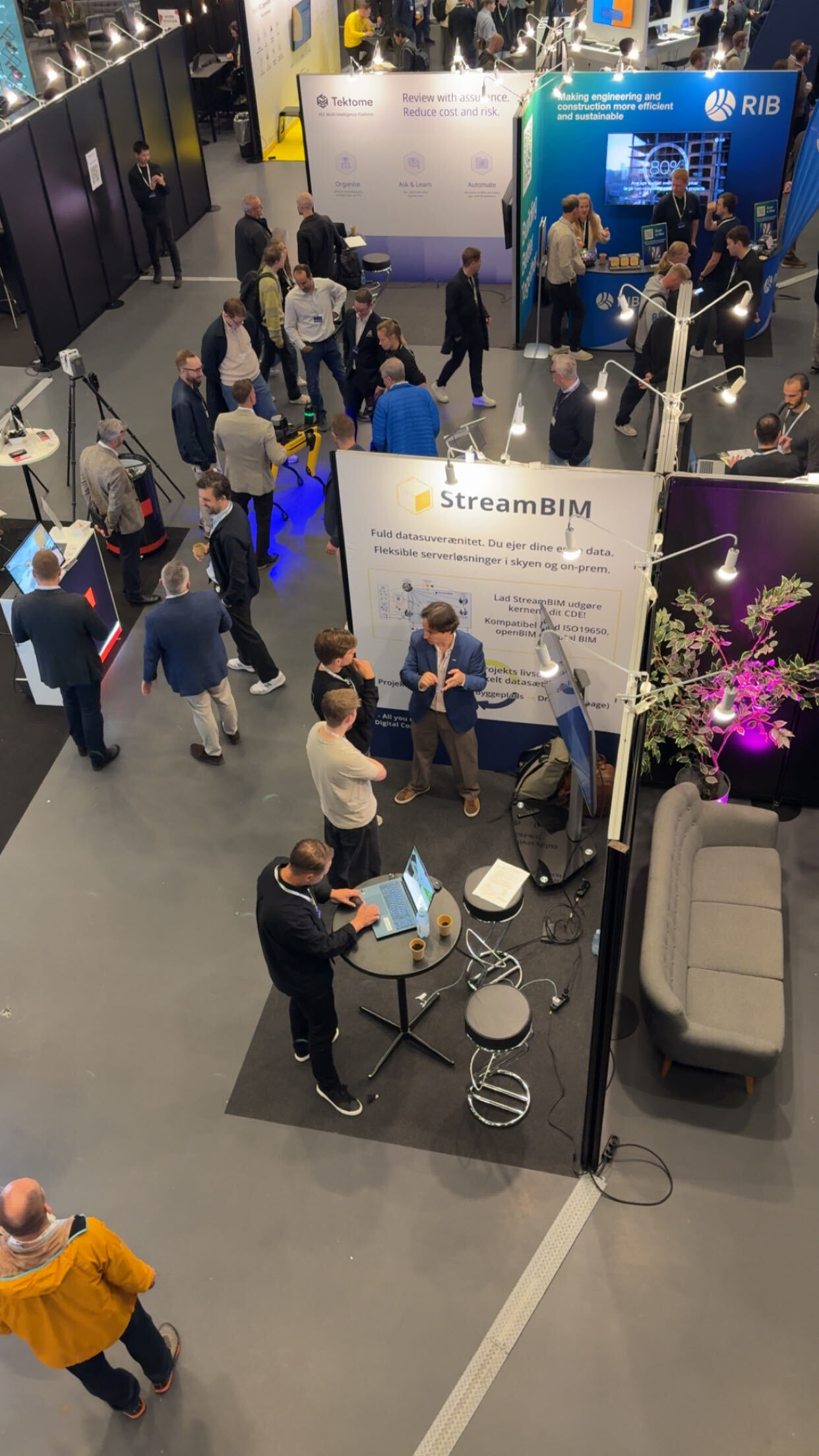

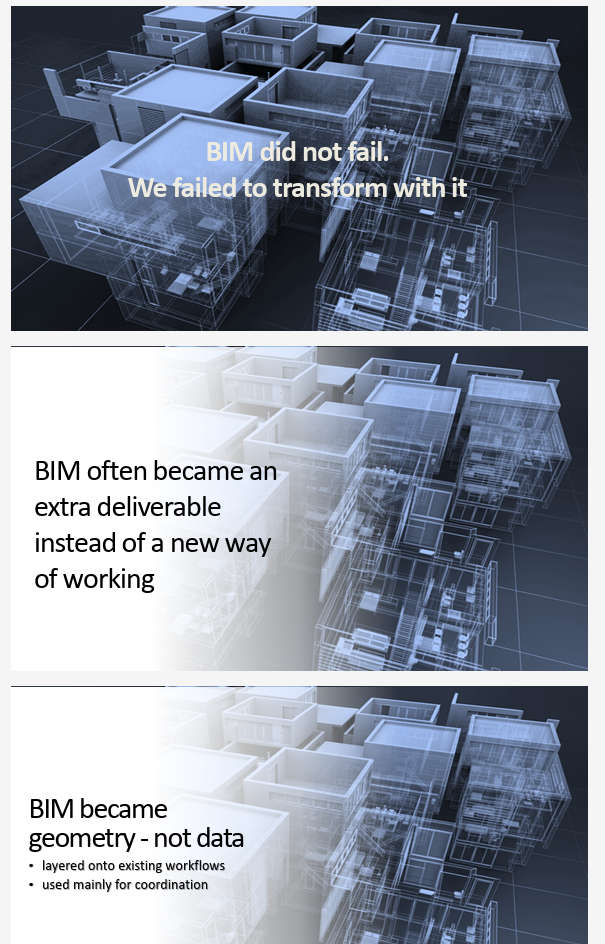
At the buildingSMART conference in Porto, one thing became clear: the industry is moving away from treating BIM as a model, a file, or simply 3D that can be viewed in a viewer. The focus is now on how information is structured and quality-assured, governed, shared securely, and used throughout the entire lifecycle. It is not that BIM has failed up to now; rather, the industry has not been able to realize the benefits to a sufficient degree. To quote a couple of slides from Porto: “BIM didn’t fail. We failed to transform with it” and “BIM often became an extra deliverable instead of a new way of working.” For owners and contractors, this means that future competition will be about what and who provides the best control, the least friction, and the highest value over time.
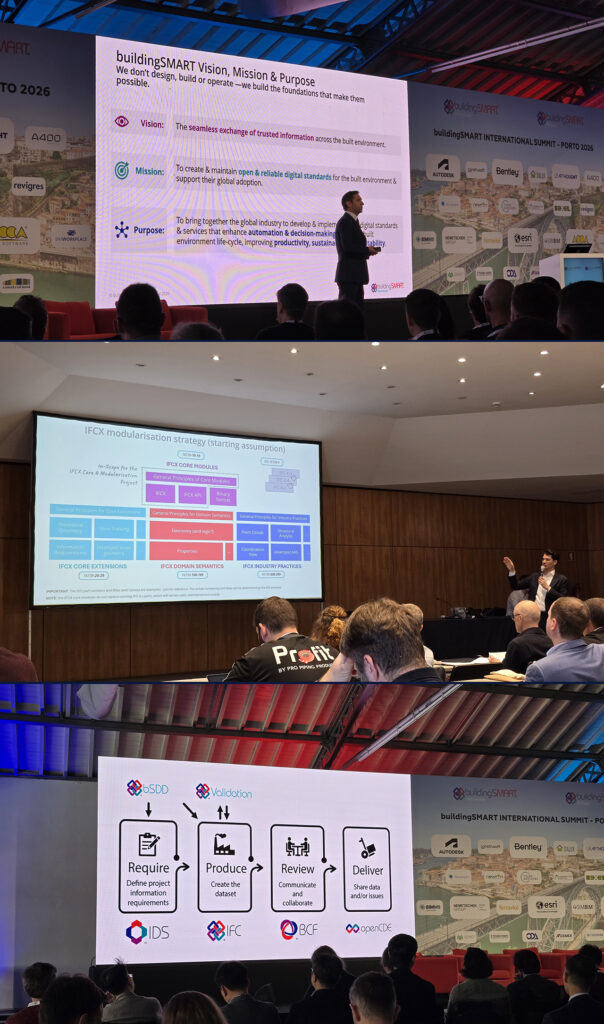
OpenBIM still matters. But it is no longer enough.
For many years, the digitalisation debate in construction and infrastructure has been dominated by standards, file formats, and the question of how models can be exchanged between stakeholders. That is still important. But in Porto, it was clear that the market is moving on.
Interoperability, workflows, data quality, asset management, and AI were treated as parts of the same challenge: how to make BIM data operational, reliable, and relevant in actual project delivery, handover, and operations.
This is a clear sign of market maturity. The industry is no longer asking only how information can be shared. It is asking how information can be used, governed, and reused without losing quality, control, or context along the way. We also see that buildingSMART is enabling more effective interaction with project data by adding new technology to the IFC schema through the IFC5/IFCX work. This is exciting for an industry that needs everyone to work against the same “project dataset”.
The real competition is not about the model alone
This is where many vendors still stop too early.
Having a BIM model is not the same as having control over the data flow around it. And OpenBIM is not, in itself, a guarantee that the information will be operationally useful for those who are actually designing, building, documenting, handing over, and operating.
It is only when the model functions as a governable and shared source of truth that it starts to deliver real business value. That means the right information must be available to the right role, in the right phase, with the right access, and in a structure that keeps it usable later in the value chain as well.
This is where the market is now drawing a clearer distinction between systems that display information and platforms that actually manage it.
For owners, this is about control, risk, ownership, and lifecycle value
For owners, this is not primarily about having a 3D model. It is about ownership of data relating to their own buildings and installations. And it is about control.
Control over who has access to what. Control over how information is changed and traced. Control over where data is stored. Control over what can actually be carried forward into operations, facilities management, and portfolio management.
In projects with high complexity, many involved parties, or stricter security and compliance requirements, this is no longer a secondary consideration. It is part of the purchasing logic itself.
The more critical and complex the project is, the more important it is to know that the data is of the right quality and available in a way that supports handover, audit, and further use. And that there is traceability regarding who has had, and who has, access. Are there copies and files out of place?
For contractors, it is about pace, flow, and less friction in production
For contractors, the value is just as important, but more operational.
Here, the problem is rarely that the information does not exist. The problem is that it is not always available in the right version, in the right context, or in a format that works when the pace is high and many disciplines must collaborate closely.
When the right basis for work does not reach people in time, when issues and clarifications live in parallel tracks, or when documentation becomes something that has to be gathered afterwards, friction increases. It costs time. It costs quality. And it costs margin.
That is why one updated and quality-assured source of truth is not just a digitalisation ideal. It is sound production economics.
That is why security, ownership, and on-prem are becoming more important now
The more BIM data is to be used in operations, analytics, automation, and AI, the more important it becomes to ask the questions that were previously often pushed aside:
- Who owns the data?
- Where is it stored?
- Who has access to what?
- What can be traced?
- What can be reused?
- And how dependent does the customer become on a closed ecosystem?
These are no longer just technical or legal questions. They are business-critical questions.
That is also why on-prem and data residency are moving from being niche requirements to becoming strategic buying criteria in more parts of the market. When risk is high, or information requirements are strict, flexibility in hosting, clear access control, and auditable control become a competitive advantage, not just a technical specification.
Why this makes StreamBIM relevant
It is precisely in this shift that StreamBIM’s position becomes clear.
StreamBIM is built around one single source of truth: the model as the hub, data as the truth, and one shared foundation throughout the entire lifecycle. With one source of truth, it is essential that the software can efficiently and intuitively present the data YOU need to do your job.
When this is combined with role-based access, auditable control, open integrations, and the ability to be deployed in the cloud, on a local server (online), and on a local server (offline/on-prem) as needed, StreamBIM becomes more than a model viewing tool. It becomes a platform for governance, collaboration, and lifecycle value.
The market does not need yet another layer on top of information fragmentation. It needs solutions that reduce data breaks between design, construction, handover, and operations, while allowing the customer to retain control of their own data.
Our position
In the years ahead, value will shift from having BIM data stored on a file server to active use, where it can be maintained, governed, protected, and used throughout the entire lifecycle.
The platforms that win are not the ones that simply display the model best. They are the ones that give owners more control, contractors better flow, and both parties a safer and more usable data foundation from project start to operations.